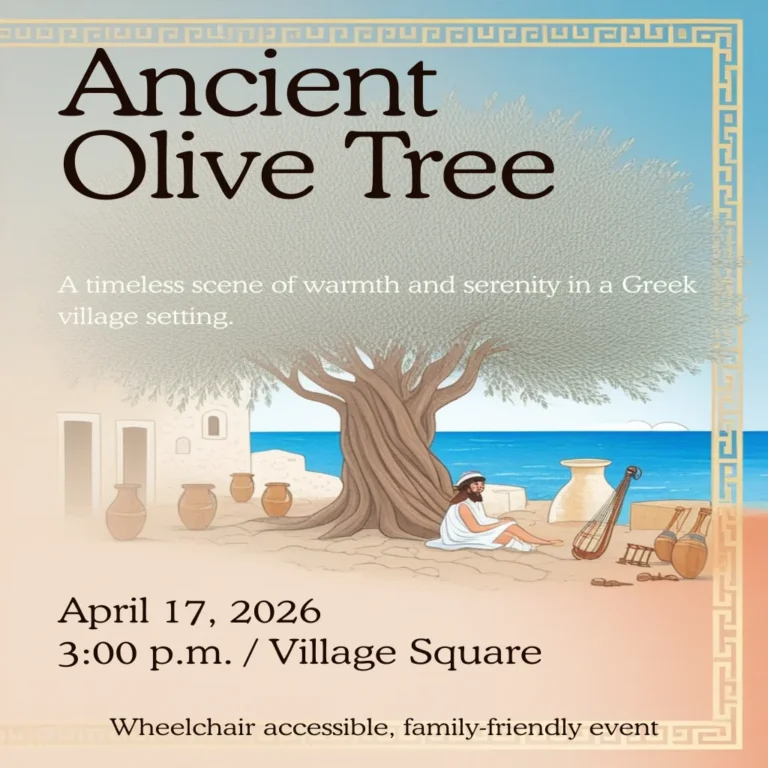
The Stranger at the Olive Tree
But one morning in late summer, Lyra woke to the sound of her mother crying.
She ran outside in her bare feet, the cool stones of the path sharp against her soles, the smell of salt blowing in strong off the nearby sea. The whole village had gathered in the square. There stood the great olive tree — and every single one of its leaves had turned white as chalk and fallen, silent and still, to the ground. The bare branches reached into the bright blue sky like the fingers of someone asking for help.
"It is a sign," said the village elder, Nestor, his white eyebrows pulled into a deep frown. "Athena has turned away from us."
Nobody moved. Nobody spoke.
Then Lyra saw her.
Sitting at the very base of the tree, half-hidden by fallen white leaves, was an old woman. She was thin as a winter branch, wrapped in a gray robe, and her eyes were the exact color of the sea just before a storm — silver, deep, and very still. She looked at Lyra the way the sea looks at the shore: like she had been waiting.
The other villagers hadn't noticed her. Or perhaps they had, and were too frightened to look.
Lyra stepped forward. Her heart knocked hard against her ribs.
"Are you hungry?" Lyra asked. "Are you thirsty?"
It was the law in all of Greece — the sacred law of *xenia*, the ancient rule of hospitality — that a stranger must be offered bread and water before questions are asked. Lyra knew this the same way she knew her own name.
The old woman smiled, and just for a moment her face seemed to glow faintly — the way the sky does in the last second before the sun slips below the sea.
"You are the only one who has spoken to me," the old woman said. Her voice was like wind moving through living leaves.
Lyra brought bread from her own house. She brought water from the well. She sat down in the dirt beside the old woman and shared what she had. This is exactly the kind of moment the best stories for kids ages 6-12 are made of — the small, quiet choice that changes everything.
"The tree is sick," the old woman said, "because the spring that feeds its roots has been blocked. A boulder rolled down from the hill in the last storm and sits now over the mouth of the spring. The water cannot reach the tree."
"Then I'll move it," said Lyra.
"The boulder is very large," the old woman said. "The path to the spring runs through the Dark Pass — the narrow gap between the cliffs where the bats live and the shadows never lift. No one from this village will go there."
Lyra swallowed hard. She had heard stories about the Dark Pass. Everyone had. But she looked at the bare white tree, its branches empty and reaching, and she stood up.
"Will you tell me which way to go?" she said.
"I already have," said the old woman — and when Lyra blinked, she was gone. Nothing remained but a single olive leaf, green and perfect, lying on the ground where the woman had sat.
Lyra held it in her palm the entire way up the hill.
The Dark Pass was everything the stories had promised. The walls of rock pressed in from both sides, so close she had to turn sideways to squeeze through. It smelled of cold stone and old water and something sharp, like the air before lightning strikes. Above her, bats rustled and breathed in the deep shadows. She could feel the darkness like a heavy cloth pressing against her eyes.
She kept moving.
Her hands were cold. Her legs trembled. But she thought of the tree — its five hundred years, its whispering silver leaves, its bare branches asking the sky — and she did not stop.
At the far end of the pass, she found the spring: a small, bright, burbling thing, sweet as honey when she knelt and tasted a single drop from her fingertip. And there sat the boulder, enormous and gray, plugging the very place where the water wanted to flow.
Lyra looked at it for a long, quiet moment. Then she looked at the hillside around it, and she saw something. A long, flat slab of rock lay wedged nearby — a natural lever, exactly like the one her father used to lift heavy clay pots from the kiln. She braced it against a smaller stone, positioned it carefully beneath the boulder's edge, and pushed with every bit of strength she had.
The boulder groaned. It resisted. It teetered.
Then, with a deep thud that she felt all the way up through her arms and shoulders, it rolled aside.
The spring leaped forward — cold and singing and alive — rushing down the hillside in a thin silver thread, reaching for the ancient roots far below.
By the time Lyra walked back into the village square, her tunic muddy and her hair full of pale dust, the olive tree was already changing. Tiny green buds pushed out along every branch — bright, fresh, glowing. By sunset, the tree was full and silver again, its leaves catching the evening light like a thousand small coins.
Nestor stared at Lyra. "How?" he said.
Lyra opened her hand and showed him the single perfect olive leaf she had carried all the way there and back.
"A stranger told me where to look," she said simply. "I only had to be brave enough to go."
No one asked who the stranger had been.
In Akanthos, they already knew.
📚 Recommended Books
Handpicked for readers like you
As an Amazon Associate, we earn from qualifying purchases. These recommendations are personalized based on this story's themes and your reading history.