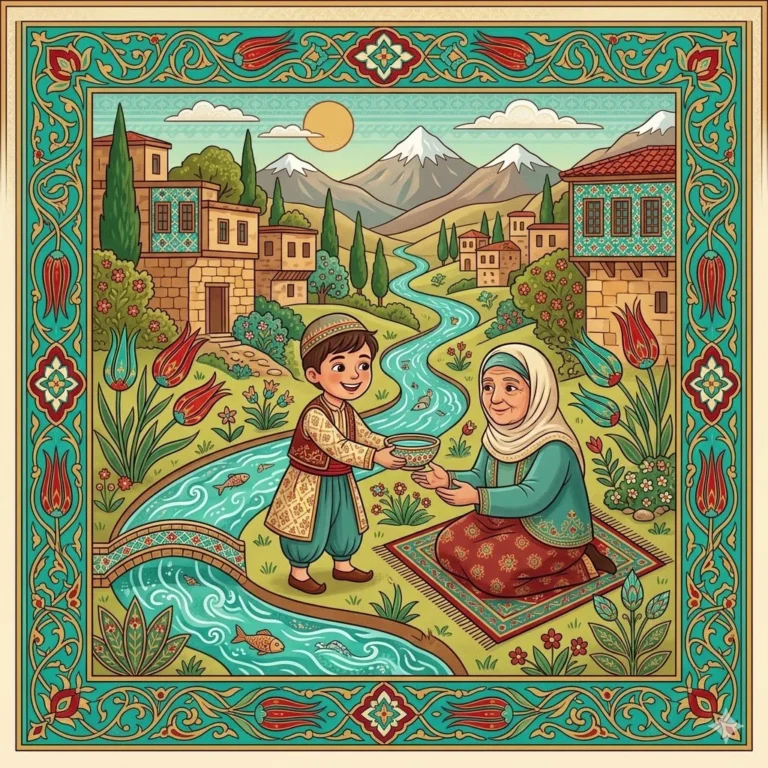
The Boy Who Spoke to the River
In a valley cupped between two amber hills, there lay a village called Sarıpınar — Golden Spring — named for the cold, clear water that had bubbled up from the earth since before anyone's grandfather's grandfather could remember. The villagers drank from it. They watered their goats and their rose bushes from it. On summer evenings, children splashed in it until their feet turned pink and the sky above turned the colour of a peach left on the sill.
Then, one dry August, the spring went silent.
The earth around the stone basin cracked like old leather. The roses drooped. The goats grew nervous and thin. The village elder, a broad-shouldered man named Hasan Ağa, called everyone to the square beneath the great mulberry tree.
"The river spirit — the Su Perisi — has sealed the spring," he announced, his voice grave as a funeral bell. "She has sent word. If anyone wishes to restore the water, they must climb to the source in the high rocks and answer her riddle. But she warns: if you answer wrong, you will be turned to a stone fish and swim in the dark forever."
No one moved. The square smelled of dust and dry leaves. Even the bravest men stared at their boots.
Then a thin hand went up.
"I'll go," said Tarık.
He was eleven years old and small for his age, with ears that stuck out slightly and a habit of asking questions that made adults sigh. His mother grabbed his arm.
"Tarık, you absolutely will not—"
"Grandmother told me something," he said quietly. "About the Su Perisi. I think I know what she wants."
His mother looked into his eyes for a long, searching moment — dark, steady eyes, like water at the bottom of a well — and slowly, slowly, let go.
—
The path to the source wound upward through thickets of wild thyme and pine. The air grew cooler with every step, sharp with resin and something electric, like the feeling just before lightning strikes. Tarık's sandals scraped against pale rock. His heart hammered. His feet kept moving anyway.
He heard her before he saw her.
The sound was not exactly music and not exactly rushing water — it was both at once, and also the feeling of falling in a dream. Then the rocks opened into a small hollow, and there she was: a woman made of water and silver light, her hair flowing upward as though she were always submerged, her eyes the deep green of a mountain lake just before a storm.
"A boy," she said. Her voice sounded like pebbles tumbling downstream. "The village sent a child."
"The village didn't send me," Tarık said, though his knees were trembling visibly. "I came myself."
The Su Perisi tilted her shimmering head. "Then you are either very brave or very foolish."
"My grandmother said those are sometimes the same thing."
The spirit almost smiled. *Almost.* "Very well. Here is my riddle." She raised one pale hand, and the hollow went utterly silent — no wind, no birds, no rustling pine — just the faint cold smell of stone and moss and deep earth. "I give and give and ask for nothing. I am taken for granted until I vanish. I have no voice, yet I carry every message the mountain sends. What am I?"
Tarık was quiet. He thought of his grandmother's story — the old farmer who ignored his well until it dried up, who wept at the dry stones, who learned his lesson too late and alone. He thought of the roses, the goats, the children splashing with pink feet. He thought about how nobody had said thank you to a spring in a very, very long time.
"You're not just water," he said slowly. "You're the kind of trust that lives between people and the world they've been given. The spring gives because that is its nature — endlessly, without complaint. And we stopped noticing. We started behaving as though the water belonged to us, instead of understanding that we belong to it."
The hollow filled with a sound like a hundred streams waking at once.
The Su Perisi studied him with those deep green eyes for a long time. Her silver light shifted like sunlight through moving water. Then she stepped aside, and behind her, from a crack in the ancient grey rock, water came rushing out — cold, so cold it made the air taste of iron and snow. It tumbled over Tarık's sandals and he gasped at the shock of it, laughing despite himself.
"Go," she said softly.
He turned to leave. Then her voice came once more, quiet as a current beneath ice.
"Tell them this: a gift only stays a gift if it is received with open hands."
—
By the time Tarık stumbled back into the village square, he could already hear the sound of water filling the stone basin below — a cheerful, burbling, completely ordinary miracle. People were crying. His mother was crying. Even Hasan Ağa pressed the back of his broad hand to his eyes and stared with great interest at the sky.
That night, when the village lit lanterns and the warm smell of lamb stew and fresh bread drifted through every open window, Tarık's grandmother sat beside him beneath the mulberry tree. She said nothing for a long while. Just held his hand, her fingers dry and warm as bread straight from the oven.
"I told you her riddle," she said finally.
"You told me a story," Tarık said. "I figured out the riddle myself."
She laughed — a low, delighted sound, like water finding its way around a stone.
📚 Recommended Books
Handpicked for readers like you
As an Amazon Associate, we earn from qualifying purchases. These recommendations are personalized based on this story's themes and your reading history.
Outside, under a sky thick with stars, the spring sang cheerfully in the dark.