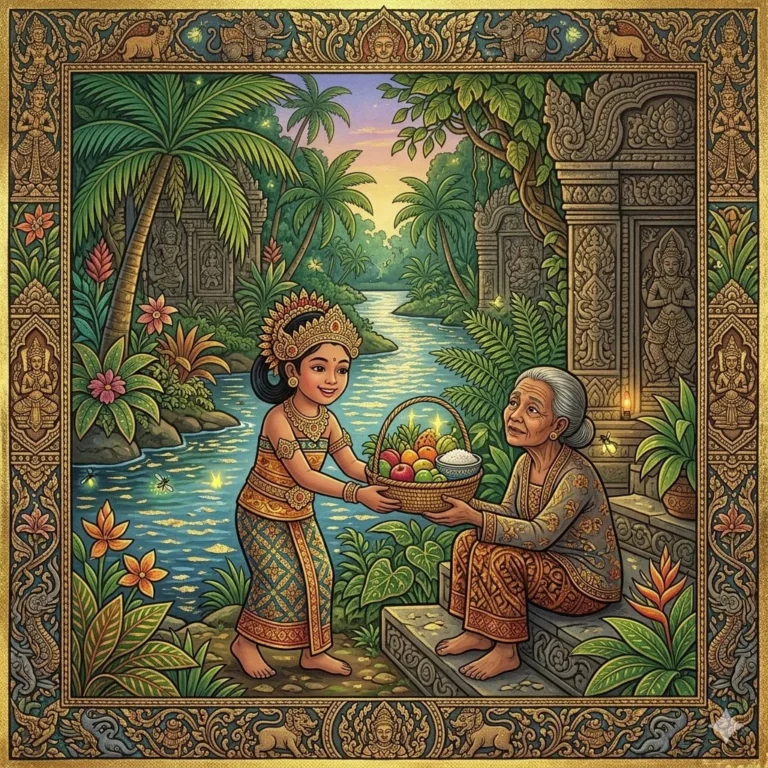
The Girl Who Spoke to the River
—
In the village of Kampung Biru, where the banana leaves whispered against one another all day long and the air smelled of coconut smoke and wet earth, there was a river that had always run silver and cold from the mountain above.
Until the day it stopped.
For seven mornings, the children woke to find the riverbed nothing but cracked clay and smooth stones baking in the sun. The rice paddies curled at their edges. The water jars grew light. And the old men of the village gathered under the tamarind tree, shaking their heads and saying what everyone feared to say aloud: *the Naga had withdrawn his blessing.*
The Naga — the great serpent spirit who lived where the river was born, deep in the forest above — was not to be disturbed. Everyone knew this. The grandmothers had said so for generations.
But Lila, who was nine years old and had always found silence harder to bear than danger, could not stop watching her little brother press his dry lips together and say nothing when he was thirsty.
She went to her grandmother, who sat shelling tamarind pods on the porch, her fingers brown and quick as sparrows.
"Nenek," Lila said, crouching beside her, "what if someone went to speak to the Naga? Not to fight him. Just to *ask*."
Her grandmother's hands went still. She looked at Lila for a long moment — the kind of look that weighs a person, measures their bones. "The last man who went to that part of the forest came back without his voice," she said quietly. "He could never speak again."
"But he went to demand," said Lila. "I would go to listen."
Another long silence, filled with the dry rustle of palm fronds and the distant sound of a child crying somewhere in the village. Her grandmother pressed a small carved wooden bead into Lila's palm — cool, smooth, smelling faintly of sandalwood. "Then go before sunrise," she said, "while the forest is still half-dreaming."
—
The path into the mountain forest was nothing like the friendly trails Lila knew. The trees here were ancient, their roots rising from the soil like the knuckles of buried giants. Moss covered everything in a thick, cold green silence. The air smelled different — darker, somehow, mineral and damp, like the inside of a stone jar. Lila's feet sank into the soft ground with each step, and somewhere ahead, unseen water dripped in a steady, patient rhythm.
She followed the sound.
The spring where the river was born was a black pool circled by fig trees so old their trunks had fused together. And at the edge of the pool, half-submerged in shadow, lay the Naga — coiled and enormous, his scales the color of deep water, his great head resting on the stone bank. A low sound came from him, not quite a hiss, not quite a groan. A sound of pain.
Lila's heart hammered so hard she could feel it in her throat. She knelt at the edge of the pool.
"Great Naga," she said, and her voice came out steadier than she expected, "I haven't come to take anything from you. I came because my village is thirsty and I thought — maybe you are suffering too."
One enormous eye opened. It caught the faint predawn light and held it, glowing amber and gold.
"You are a child," said the Naga. His voice was like water moving over deep rock. "Children do not come here."
"I know," said Lila. "But the wise people in my village are afraid, and I am only a little afraid, and sometimes a little afraid is enough to move."
The Naga regarded her for a long moment. Then he shifted — a slow, heavy movement — and Lila saw it: wound around one of his coils, digging into the soft place beneath his scales, was a length of old iron chain, rusted and crusted with decades of forest debris. Someone, long ago, had tried to bind him. The chain was not tight enough to hold him, but it had worked its way beneath his scales like a splinter, impossible to reach with his own great head.
Lila did not wait to be asked. She pulled her small knife from her belt, moved to the edge of the pool, and waded in. The water was cold enough to make her gasp — cold as mountain rain, cold as the moment before dawn. She worked carefully, prying the chain away from his scales, her fingers slipping on the rust and the wet. The Naga remained still, watching her with one luminous eye.
It took a long time. When the chain finally came free and sank into the mud, the Naga let out a breath like wind through a canyon.
"You could have run," he said.
"I could have," Lila agreed, wading back to the bank, her legs trembling, the wooden bead still pressed in her fist.
"Why didn't you?"
She thought about it. About her brother's dry lips. About her grandmother's careful hands pressing the bead into her palm. About the difference between the man who had come demanding and the girl who had come listening.
"Because you needed help," she said simply. "And I was here."
—
By the time Lila descended from the forest, the river was running again — cold and silver and generous, tumbling over the stones with a sound like children laughing. The whole village came out to stand at its banks, cupping the water in their hands, pressing it to their faces.
Her grandmother found her at the river's edge, soaked to her shins, hands scraped from rust. She said nothing. She simply took Lila's face between her two warm palms and held it there, the way you hold something you almost lost.
📚 Recommended Books
Handpicked for readers like you
As an Amazon Associate, we earn from qualifying purchases. These recommendations are personalized based on this story's themes and your reading history.
This gentle tale is best shared for kids ages 6-12 on a quiet evening, when the world outside is soft and the night is just beginning its long, dark conversation with the stars.