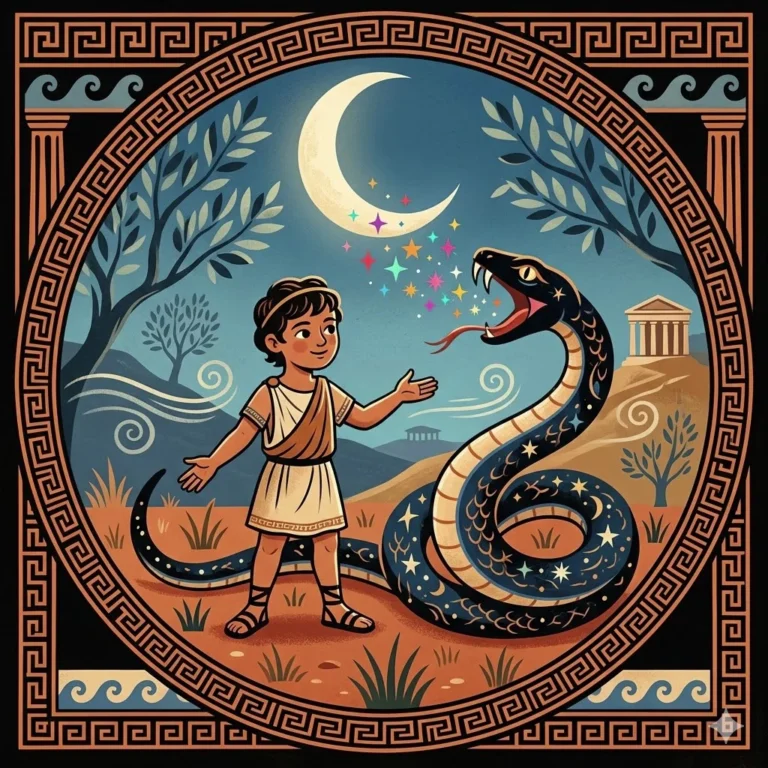
The Serpent Who Swallowed the Stars
—
In the village of Ambrosios, where the mountains breathed cold pine-scent down into the valley and the goat bells rang like tiny silver prayers at dusk, there lived a girl named Thessaly.
She was twelve years old, with ink-stained fingers and a leather satchel always fat with scrolls. The other children laughed at her habit of asking *why* — why the stars moved, why bees loved lavender, why the old men left offerings of honey and figs at the cave mouth on Mount Keras. But Thessaly only smiled and wrote down everything she noticed.
The cave on Mount Keras had always been there. But the serpent inside it had not.
It arrived one autumn — enormous, scaled in midnight blue, with eyes like burning torches. It stretched so long that its tail disappeared into the darkness while its head blocked the cave's wide mouth. It did not attack the village. Instead, it spoke. Its voice was the sound of boulders grinding together beneath the earth.
*"Bring me what I ask, or I shall breathe my venom-mist into your wells."*
It asked for gold first. The elders gave it. Then silver. Then grain — three seasons' worth, until the storehouses groaned empty. Now winter was coming, and the serpent had asked for something the village could not give: a warrior brave enough to answer its riddle. If the warrior answered correctly, the serpent would leave forever. If they answered wrong, the warrior would stay in the cave as the serpent's shadow — a prisoner of darkness — and the venom would poison the wells regardless.
Three warriors had already walked up the mountain path, clanking with armour and confidence. Three warriors had not returned.
On the morning of the fourth day, Thessaly stood before the elders in the village square, where the fountain smelled of cold stone and wet moss.
"Let me go," she said.
The eldest — a man named Doros, whose beard was white as sea-foam — squinted at her. "Child, three grown soldiers have been swallowed by that darkness."
"Three grown soldiers who trusted their swords more than their minds," Thessaly said quietly. She did not say it unkindly. She said it the way one states that rain is wet.
Doros was silent for a long moment. The wind moved through the olive trees above them, making a sound like silk being torn. Finally he exhaled. "Very well. What warrior worth their salt do we have left?"
Thessaly walked up the mountain.
The path smelled of thyme and old rain. The pine trees grew darker and taller as she climbed, and the cold settled against her skin like a second garment, pressing. She could hear the serpent before she saw it — a low, rhythmic rumble, like thunder that had decided to rest.
The cave entrance was vast. The serpent's scales caught the thin winter light and broke it into blue fire. Its eyes fixed on her, two torches in the dimness.
*"A child,"* it said, amused. The sound vibrated in her chest. *"The village scrapes the bottom of its barrel."*
"I am the sharpest thing in the barrel," Thessaly said. Her knees trembled. She did not let them show in her voice.
*"Then answer me this. I am always coming but never arriving. I am in every promise and every seed. Kings fear me and so do beggars. I have no body, yet I shape everything. What am I?"*
Thessaly breathed slowly. She thought of her scrolls — the philosophers she had read by lamplight while the rest of the village slept. She thought of the warriors who had come before her. They had probably grabbed the first answer their fear offered them and shouted it like a battle cry.
She stood very still and thought.
*Tomorrow,* the fear in her said. *The answer is Tomorrow.*
But she paused. She turned the riddle over like a smooth stone in her palm. Tomorrow was always coming and never arriving — yes. Tomorrow shaped plans and hopes — yes. But tomorrow did not make *kings* fear it the way kings truly feared. Kings were afraid of something they could neither conquer nor buy.
She breathed in the cave-smell — cold stone, old bronze, something ancient and wild.
*Time,* she thought.
"Time," she said aloud. "Time is always coming and never arriving — the next moment forever just ahead. Time is in every promise and every seed, because both require time to be fulfilled. Kings fear time because it will outlast them, and beggars fear it because they have so little. Time has no body, and yet it shapes everything that has ever lived."
Silence.
The serpent's burning eyes regarded her. The rumble in its chest changed pitch — lower, slower, like water finding its level.
*"The warriors before you,"* it said, *"shouted 'Tomorrow' and 'Death' and 'The Future.' Close, but not precise. They answered with the first fire in their blood."*
"They were brave," Thessaly said. "They just didn't wait long enough to think."
*"And you? Were you not afraid?"*
"I was terrified," she said honestly. "But being afraid and being foolish are two different things."
The serpent was quiet for so long that the wind moved past the cave mouth with a low, mournful moan. Then — slowly, impossibly — it began to retreat. The vast blue body uncoiled, pulling back into the darkness like a tide going out, until even the burning eyes had dimmed to nothing.
Thessaly stood alone at the cave mouth, her heart hammering like a blacksmith at his anvil. The valley below her was golden in the thin winter sun. She could smell pine resin and distant woodsmoke from the village hearths.
She walked back down the mountain.
When she reached the square, Doros looked at her — just her, whole and unhurt — and asked no questions. He simply placed his hand on her head, the way her grandfather used to.
Later, the village filled the storehouses again, slowly, season by season. They always left the cave alone after that.
📚 Recommended Books
Handpicked for readers like you
As an Amazon Associate, we earn from qualifying purchases. These recommendations are personalized based on this story's themes and your reading history.
And Thessaly kept asking *why* — and kept writing down everything she noticed.