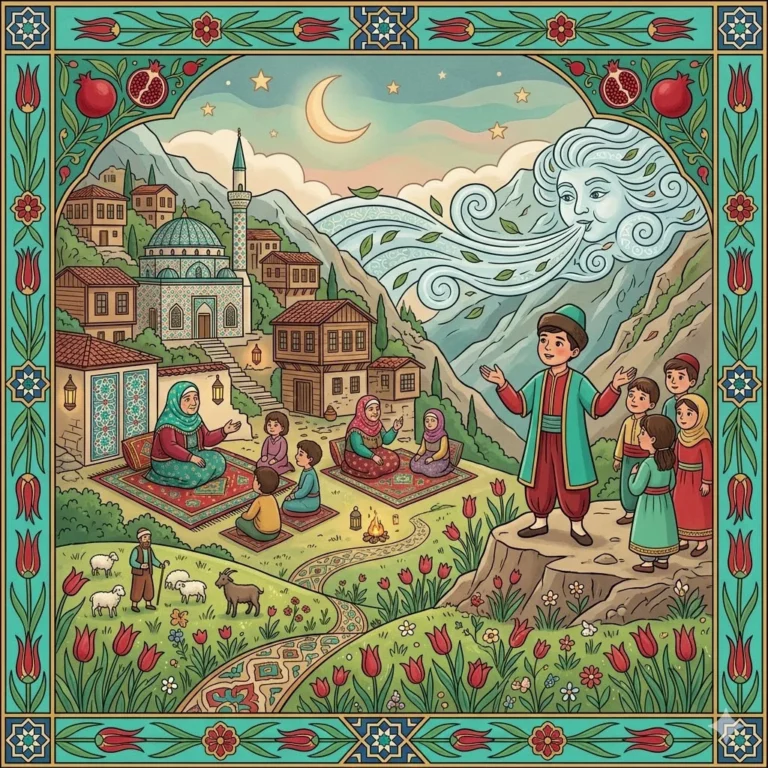
The Boy Who Bargained with the Wind
—
High in the hills above the town of Taşköy, where the pine trees grew so thick the sunlight fell in coins on the ground, there lived a boy named Kerem. He was eleven years old, gap-toothed, and stubborn in the way that useful people often are.
One autumn morning, Kerem's grandmother fell ill. Her breath came in small, ragged sips, like a candle flame fighting to hold on. The healer who could help her lived on the other side of Mount Gökbel — a half-day's walk — but the only path crossed the Whistling Saddle, a narrow ridge known for its howling, skin-cutting wind. Grown men came back from that crossing with frost on their eyebrows and fear in their eyes.
Kerem's father was away at the market in the city. There was no one else.
He was lacing up his boots by the door when old Dede Yusuf hobbled in from next door, leaning on his walnut walking stick. The man was ninety years old and smelled of dried figs and woodsmoke.
"Where do you think you are going, little pomegranate?" the old man asked, eyeing the path Kerem was staring at.
"To fetch Healer Fatma," Kerem said, and his voice did not shake, though his hands did. "Grandmother needs her."
Dede Yusuf studied him for a long moment. Then he sat down on the stone step, groaning softly, and patted the space beside him.
"Before you go," the old man said, "let me tell you what the wind is."
Kerem almost said there was no time. But something in Dede Yusuf's eyes — still as deep water — made him sit.
"Once," Dede Yusuf began, his voice low and unhurried as smoke rising, "the wind was a young prince. He had no kingdom, no horse, no crown — but he had the whole sky. He was proud of this. So proud that whenever he met something he could not move, he howled and blustered and made a great fuss, hoping the noise would do what his strength could not."
Kerem listened, his fingers tight in his lap.
"But there was a girl," Dede Yusuf continued, "a weaver's daughter, who walked the mountain roads with a red shawl wrapped around her shoulders. One day the prince-wind tried to take it from her. He roared, he spun, he screamed like a kettle. She did not run. She did not beg. She looked up at the invisible howling and said, *'You are strong, Wind. That is true. But strong is easy. What can you do that is hard?'*"
Dede Yusuf paused to let the valley breathe around them.
"That question," he said quietly, "startled the wind into silence. No one had ever asked him such a thing. And in that silence, the girl walked through."
Kerem turned this over in his mind like a smooth river stone. Then he stood up, adjusted his wool coat against the sharp-smelling autumn air, and kissed the old man on the forehead.
"Thank you, Dede," he said.
The old man watched him go with a small, tucked-in smile.
—
The path up to the Whistling Saddle smelled of cold earth and pine resin. Kerem's boots crunched over frost-stiff grass, and with every step upward the air grew leaner and meaner, as though the mountain were testing how much of him was real. By the time he reached the ridge, the wind arrived like a wall.
It was enormous. It pushed the breath back into his throat and made his eyes stream silver tears. Loose stones skittered away from his feet. The sky above the saddle was a bruised, moving purple, and the sound — a long, furious shriek — pressed against his eardrums like fists.
Kerem planted his feet wide and looked up into the invisible howling.
"You are strong, Wind!" he shouted, just as the weaver's girl had. "That is true!"
The wind screamed louder, as if the familiarity of those words offended it.
"But I have a question!" Kerem bellowed, gripping the strap of his pack. "My grandmother is sick! A healer is on the other side of this mountain! What can you do — you, with all your power — that is *harder* than helping a boy reach her?"
There was a long, shuddering pause.
Then — and Kerem would describe this for the rest of his life, and no one would fully believe him — the wind changed direction. Slowly, groaning like an old door, it shifted. Instead of pushing against him, it pushed at his back. Not gently. The wind didn't know how to be gentle. But it pushed him *forward*, and Kerem walked that ridge in half the time it should have taken, leaning into a roaring escort that smelled of far-off rain and mountain ice.
He did not look back. He simply walked, eyes streaming, heart hammering, chin up.
—
Healer Fatma reached his grandmother by midafternoon, carrying her bag of dried herbs and her calm, capable hands. By evening, the old woman's breathing had steadied. The house filled with the warm, green smell of boiled sage.
That night, as Kerem sat by the fire with wind-burned cheeks and boots still wet, his grandmother reached out and held his hand. Her grip was thin but firm.
"How did you get through the Saddle?" she whispered.
Kerem looked at the fire for a moment, thinking of Dede Yusuf, thinking of a weaver's daughter in a red shawl, thinking of the strangest, most enormous silence he had ever heard.
"I asked the wind a hard question," he said.
📚 Recommended Books
Handpicked for readers like you
As an Amazon Associate, we earn from qualifying purchases. These recommendations are personalized based on this story's themes and your reading history.
His grandmother looked at him for a long time. Then she closed her eyes, still holding his hand, and smiled.