The Riddle in the Merchant's Tower
—
The village of Al-Nakhil sat at the desert's edge like a green thumbprint pressed into sand. It smelled of cardamom and warm bread and date palms, and every morning you could hear the well-rope singing as the women drew water — cold, sweet water that never ran dry.
Then the merchant Khalid arrived.
He wore robes the color of blood oranges and rode a camel draped in silver bells. He smiled at everyone, and for a whole month he traded fairly. Then one moonless night, while the village slept, he crept to the ancient well and removed the sacred blue stone set into its wall.
The next morning, the elder — old Umm Hanan — gathered the villagers beneath the shade of the great palm. "That stone was placed here by our ancestors," she said, her voice rough as sun-dried clay. "It is bound to this water. Without it, the well runs dry in seven days."
Khalid had already retreated to the old tower at the oasis's edge, bolted its iron door, and sent word: return the stone in exchange for half the date harvest — every year, forever.
Tariq's father shook his head. "He is too powerful. We must pay."
But Tariq said nothing. He was twelve years old, small for his age, with ink-stained fingers and a habit of listening more than he spoke. That evening, he visited Umm Hanan alone.
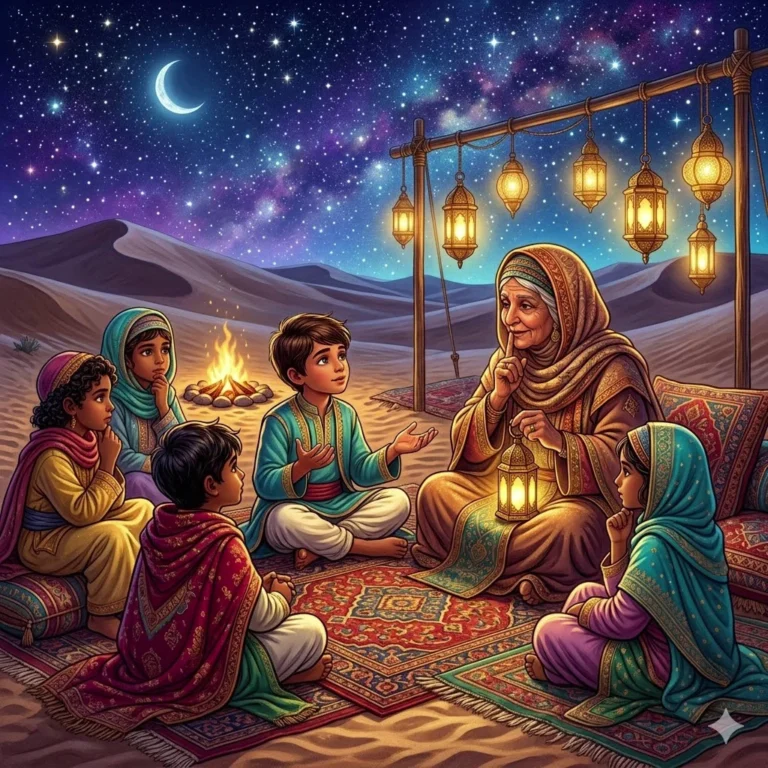
Her tent smelled of rose water and dry parchment. She sat cross-legged, her hands wrapped around a cup of tea so hot it steamed into the cool night air.
"He has guards," Tariq said.
"He does," said Umm Hanan.
"He won't trade fairly."
"He won't."
Tariq chewed the inside of his cheek. "But he *thinks* he's clever."
Umm Hanan studied him for a long moment, then smiled so deeply the wrinkles gathered around her eyes like ripples in desert sand. She reached into the folds of her robe and pressed something cool and smooth into his palm — a small white pebble, polished as a tooth. "This," she whispered, "is all you need. If you're brave enough to walk in there."
The next morning, Tariq crossed the oasis alone. His sandals crunched on hot gravel. The air tasted of iron and salt. The guard at the tower door — a broad man with a red beard and a long spear — looked down at the boy with something between amusement and confusion.
"I have a riddle for the great merchant Khalid," Tariq said calmly. "If he can answer it, I walk away and never return. If he cannot — he returns the stone."
The guard disappeared inside. After a long moment, the door swung open.
The tower's interior was cool and shadowed, heavy with the smell of incense and old metal. Khalid's treasure chests lined every wall. Khalid himself sat upon a cedar chair, his orange robe glowing in the dimness, one eyebrow lifted with lazy interest.
"A boy," he said. "With a riddle."
"With a riddle," Tariq agreed. He held up the white pebble between two fingers. "I place this in your hand. You cannot look at it yet. I declare it is black. Prove me wrong — without looking."
Khalid's eyes gleamed. He reached out, plucked the pebble from Tariq's fingers — and glanced at it. White, clearly. He opened his mouth to announce his triumph.
But Tariq spoke first. "You've already looked."
Khalid paused.
"A truly clever man," Tariq continued, his voice quiet and even, "would have simply dropped the pebble among the white gravel at your feet. Then no one could ever prove its color. The game would be unwinnable — by either of us. But you *couldn't* do that." He met the merchant's eyes. "You couldn't resist *knowing*. You couldn't resist *winning*. So you looked. And now I've won."
The silence in the tower was absolute. Outside, the camel bells swayed in the desert wind with a sound like distant rain.
Something behind Khalid's polished expression shifted — cracked, the way overheated clay cracks before it crumbles. He looked at the pebble in his palm. He looked at the boy standing before him without a sword, without a guard, without anything but a steadiness in his dark eyes.
He rose without a word and opened the largest chest. The blue stone lay inside, glowing faintly, like a piece of captured sky. He placed it in Tariq's hands.
It was cool as well-water, and Tariq felt it humming softly against his palms — a low, quiet pulse, like something waking up.
He walked out without looking back.
Behind him, the merchant called out: "Who taught you that trick, boy?"
Tariq paused at the threshold. The desert blazed gold before him. "An old woman," he said, "with very hot tea."
That evening, the well-rope sang again. The water that came up was cold and sweet, and the whole village of Al-Nakhil stood around it in the amber light, listening to it splash. Umm Hanan was the last to arrive. She pressed a cup of tea into Tariq's hands, said nothing at all, and looked at him with those deep, rippled eyes for a long and satisfied moment.
📚 Recommended Books
Handpicked for readers like you
As an Amazon Associate, we earn from qualifying purchases. These recommendations are personalized based on this story's themes and your reading history.
Tariq drank the tea. It was, as always, almost unbearably hot — and perfect.