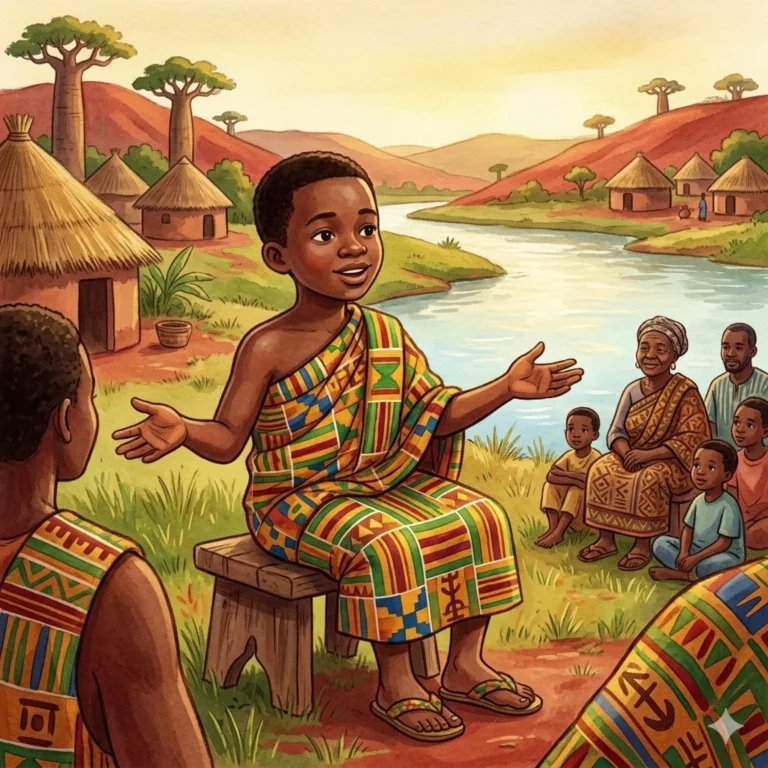
The Boy Who Spoke to the River
—
The dry season had come like an uninvited elder — proud, immovable, and slow to leave. The maize stood brittle in the fields. The goats pressed their noses to cracked mud where water once pooled. And the great river, which the village called Ama, had shrunk to a thin silver ribbon behind a wall of jagged black rocks that nobody had ever seen before.
The elders said a water spirit, old and proud, had grown angry. They sent offerings — woven baskets, bright cloth, honey pressed from the comb — but the river only murmured and did not rise.
Kofi was ten years old. He had wide, serious eyes and calloused feet from running everywhere barefoot, and he listened more than he spoke, which adults often mistook for shyness. He was not shy. He was thinking.
One dawn, before the village was awake, Kofi walked to the riverbank. The air smelled of warm dust and something faintly green — the memory of water in the reeds. The rocks jutted upward like broken teeth, and between them he heard it: not the smooth rush of the old river, but a low, strained moaning, like something enormous trying to breathe.
He crouched at the water's edge and peered between two boulders.
There, wedged deep in a crack in the rock, was a crocodile — ancient, easily as long as three men laid end to end, its hide the grey-green of deep water shadows. One of its great hind legs was caught between the stones. It could not move. Its eyes, yellow as sunlight through leaves, found Kofi's eyes.
Kofi's heart hammered so loud he was sure the crocodile could hear it.
He turned and ran — but not back to the village. He ran to the edge of the trees where old Nana Abena sat each morning grinding grain, because Nana Abena had been alive long enough to have opinions about everything, including crocodiles.
"Nana," he said, breathless, "there is a crocodile trapped in the rocks. It is very large. I think it is the reason the river is blocked."
Nana Abena did not stop grinding. "And what do you plan to do about it?"
"I want to free it."
Now she stopped. She looked at him the way she looked at things she was deciding whether to trust. "A trapped animal is the most dangerous animal. It has nothing left to lose."
"I know," said Kofi. "But a dying river is dangerous too. And the crocodile hasn't hurt anyone. It's just stuck."
Nana Abena was quiet for a long time. A hornbill called somewhere in the trees, twice, then silence. "Take my walking staff," she said at last. "And take the dried fish from my basket — the whole bundle. Go slowly. And, child — look at its eyes before you look at its teeth."
Kofi took the staff and the fish, and he walked back to the river.
The morning heat was already rising off the stones. The air tasted of iron and dry grass. The crocodile watched him come. It did not thrash or snap. It was beyond that. Its breath came in long, labored pulls.
Kofi crouched a cautious distance away and held out a piece of dried fish.
"I'm not here to eat you," he said softly, which he understood was a strange thing to say to a crocodile, "and I hope you're not here to eat me."
The crocodile blinked — slow, deliberate — and did not move its jaws.
Kofi took that as an agreement.
For the next hour, he worked with the staff, levering at the stones while the crocodile lay still with a patience that seemed almost wise. The sun climbed. Sweat ran into Kofi's eyes and his arms burned and twice the staff slipped and he scraped his palms raw on the rock. He tasted blood on his lip from biting it in concentration.
Then, with a deep grinding sound that he felt in his teeth, the rock shifted.
The crocodile pulled. The leg came free.
For one heartbeat, the enormous animal was entirely still. Kofi did not move either. He was aware of every sound — the creak of stone, the thin song of the river, his own pulse in his ears.
Then the crocodile turned, slid into the water without a ripple, and was gone.
The rocks, no longer braced against the creature's body, began to loosen. Slowly at first, then in a rush and roar of white water, the river burst free. It swept past Kofi's feet, cold and strong, smelling of rain and deep mud and life, and he laughed out loud though no one was there to hear him.
By the time he walked back to the village, the sound of the river had already reached it. People were running to the banks with clay pots and children and joyful noise. Nana Abena was standing in her doorway, her old face unreadable.
"Did it try to eat you?" she called out.
"No," said Kofi. "I think it said thank you."
Nana Abena made a sound that might have been a laugh or might have been something larger than a laugh. "Come," she said. "You need to eat. And you need to tell me everything — exactly as it happened. Leave nothing out."
He sat beside her in the shade of the acacia, eating groundnut soup that smelled of smoke and pepper, and he told her all of it. She listened the way she always listened — completely, as if each word deserved its own moment of stillness.
When he finished, she handed him her walking staff. "Keep it," she said. "You've earned the right to carry something that helps things move that are stuck."
📚 Recommended Books
Handpicked for readers like you
As an Amazon Associate, we earn from qualifying purchases. These recommendations are personalized based on this story's themes and your reading history.
This story — perfect for kids ages 6-12 who love a good adventure before sleep — has traveled from grandmother to grandchild across many fires since then. And the river called Ama still runs wide and full, if you know where to look.