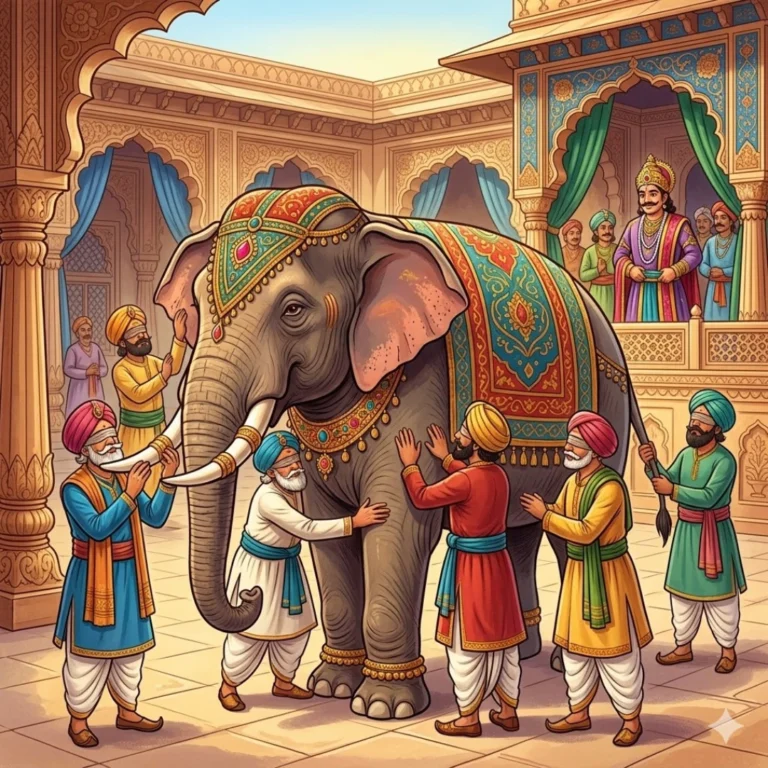
Six blind men each feel a different part of an elephant and argue about what it is—until a king helps them understand that truth is larger than any one perspective.
In an old Indian kingdom, a king decided to demonstrate something important to the wise men of his court. He had a great elephant brought to the courtyard, then invited six blind scholars to examine it.
Each man approached with confidence. Each placed his hands on a different part of the animal.
The first touched the elephant’s side. “The elephant,” he announced, “is like a wall.”
The second touched the tusk. “Nonsense! It is like a spear.”
The third grabbed the trunk. “You are both wrong. It is like a snake.”
The fourth touched the leg. “No, no. It is like a tree trunk.”
The fifth felt the ear. “What are you all talking about? It is like a large fan.”
The sixth grasped the tail. “I cannot agree. It is exactly like a rope.”
The six men began to argue loudly. The argument grew heated. Each man was absolutely sure of himself. Each man had felt with his own hands.
The king, who had been watching, raised his hand.
“Gentlemen,” he said quietly. “Each of you is correct. And each of you is completely wrong.”
Silence.
“The elephant is all of these things. The wall, the spear, the snake, the tree, the fan, the rope—each is a part of the same creature. But because none of you has touched the whole animal, you have mistaken a part of the truth for the complete truth.”
He paused. “This is what we all do, every day. We feel the part we can reach, and we announce the whole.”
The scholars went home quietly.
One of them, the youngest, did something different. He went back to the elephant the next morning, asked permission, and spent the entire day moving from one part to the other, listening, touching, asking questions.
He never became the loudest scholar. But he became the wisest.
Moral of the Story
Humility is knowing that what you can see or feel is never the whole truth. Listen to other people’s experiences—they have touched parts of the elephant you haven’t reached yet.
Learn These Words
- perspective
- a particular way of thinking about or seeing something
- scholar
- a person who studies a subject deeply
- demonstrate
- to show something clearly by using examples
- mistaken
- wrong about something
- humility
- a modest view of your own importance; not thinking you know everything
Test Your Understanding
1What did the first blind man think the elephant was like?
2Why did all six scholars argue?
3What did the king tell the scholars?
4What did the youngest scholar do differently?
5What lesson does this story teach?
Frequently Asked Questions
What is the moral of The Blind Men and the Elephant story?
The moral is that truth is often much larger than any single perspective. Each blind man was partly right but also wrong because he mistook his limited experience for the whole truth. The story teaches children—and adults—to stay humble, listen to others, and understand that combining different viewpoints gives us a fuller picture of reality.
Where does The Blind Men and the Elephant story originally come from?
The parable originates from ancient India and appears in Hindu, Buddhist, and Jain traditions, dating back thousands of years. It has been retold across many cultures and languages. One well-known English version is the 19th-century poem by John Godfrey Saxe. The story’s universal theme of perspective and humility keeps it relevant worldwide.
What does each blind man think the elephant is?
Each man touches a different part and draws a different conclusion. The one who touches the side says it’s a wall, the tusk feels like a spear, the trunk seems like a snake, the leg resembles a tree trunk, the ear feels like a large fan, and the tail is compared to a rope. All are partly correct but incomplete.
📚 Recommended Books
Handpicked for readers like you
As an Amazon Associate, we earn from qualifying purchases. These recommendations are personalized based on this story's themes and your reading history.
What age group is The Blind Men and the Elephant story best suited for?
This story works well for children ages five and up, though its deeper lessons about perspective, empathy, and open-mindedness resonate with all ages. For younger kids, it’s an engaging tale about an elephant and a funny argument. For older readers, it sparks meaningful discussions about bias, limited knowledge, and respecting differing viewpoints.
How can I use this story to teach kids about respecting different perspectives?
After reading the story, ask children to describe a familiar object from just one angle—then reveal the whole thing. This hands-on activity mirrors the blind men’s experience. Discuss how arguments often happen when people only see part of the picture. Encourage kids to ask questions and listen before assuming they know the full truth.