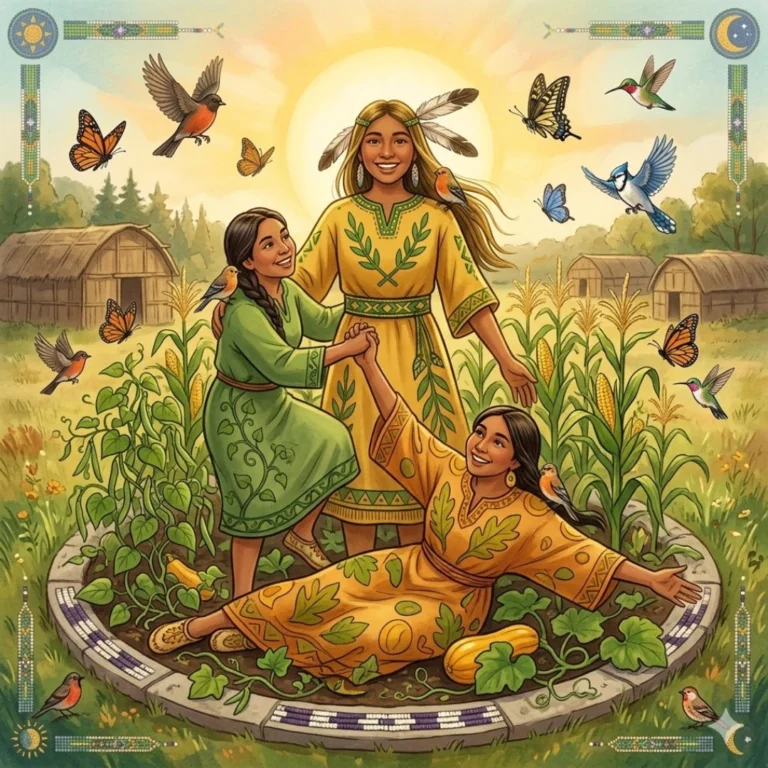
Corn, beans, and squash learn that they grow stronger together than apart—teaching children the power of working as a team.
Long before Europeans came to North America, the Haudenosaunee (ho-dee-no-SHOW-nee) people had a secret—three sisters who could not survive without each other.
Sister Corn grew tall and golden. She stood up straight and proud, reaching for the sun. But she was lonely and could not hold herself up in the wind. She fell over and cried.
Sister Bean grew lush and green, with tendrils that needed something to climb. But she had nothing to hold onto, and she sprawled on the ground, her leaves yellowing. She cried too.
Sister Squash spread wide, with enormous leaves that needed open ground. But the sun beat down and dried her leaves, and the weeds crept in. She cried.
Then Grandmother came and planted them together.
She planted Corn first, and Corn grew tall. She planted Bean beside her, and Bean climbed Corn’s stalk gratefully. She planted Squash around them both, and Squash spread her great leaves over the earth.
Now Corn was held up by Bean’s tendrils and Bean’s roots fixed nitrogen in the soil making all three stronger. Bean climbed without needing anything else. And Squash’s great leaves shaded the earth so weeds could not grow and the soil stayed cool and damp.
Three plants. Three problems. Together: one answer.
Grandmother sat back and watched her garden with satisfaction. “This is what I wanted you to understand,” she said to her grandchildren. “No one of you has everything you need. Together, you have exactly what each other needs.”
The Haudenosaunee called them the Three Sisters—not because they were related, but because they could not flourish apart.
Every spring, when the gardeners plant the three seeds together, they are remembering this: the strongest thing in the world is the right kind of partnership.
Moral of the Story
Cooperation means recognising that your strengths and your neighbour’s strengths fit together. No one has everything they need alone—together, we do.
Learn These Words
- tendril
- a thin, curling stem that a climbing plant uses to hold on
- nitrogen
- a natural element in the air that helps plants grow
- flourish
- to grow strongly and healthily; to thrive
- cooperation
- working together toward a shared goal
- partnership
- a relationship where two or more people work together for mutual benefit
Test Your Understanding
1What are the Three Sisters?
2What problem did Sister Corn have alone?
3What did Sister Bean’s roots do for the others?
4What did Squash’s leaves do for the garden?
5What lesson does this story teach?
Frequently Asked Questions
What is the Three Sisters garden?
The Three Sisters garden is a traditional Native American planting method used by the Haudenosaunee people. Corn, beans, and squash are grown together because each plant supports the others—corn provides a stalk for beans to climb, beans add nitrogen to the soil, and squash shades the ground to retain moisture and block weeds.
What lesson does the Three Sisters garden story teach children?
This story teaches children the power of teamwork and cooperation. Each sister—Corn, Bean, and Squash—struggles when planted alone but thrives when planted together. It shows kids that everyone has unique strengths, and by working as a team and supporting one another, we can all grow stronger than we would on our own.
Who are the Haudenosaunee people mentioned in the story?
The Haudenosaunee (pronounced ho-dee-no-SHOW-nee) are a confederation of Indigenous peoples of North America, also known as the Iroquois Confederacy. They developed the Three Sisters planting technique long before Europeans arrived and passed down its wisdom through generations of storytelling and agricultural tradition.
📚 Recommended Books
Handpicked for readers like you
As an Amazon Associate, we earn from qualifying purchases. These recommendations are personalized based on this story's themes and your reading history.
Why are corn, beans, and squash called the Three Sisters?
They’re called the Three Sisters because, like siblings who look after each other, each plant fills a role the others need. Corn stands tall for beans to climb, beans enrich the soil with nitrogen for all three, and squash spreads broad leaves to shade the ground, keeping it moist and weed-free. Together they form a natural support system.
What age group is the Three Sisters garden story best suited for?
This story is ideal for children roughly ages 3 to 8. Its simple, personified characters and gentle narrative make it easy for young listeners to understand. The moral about cooperation and using your unique strengths to help others is accessible and relatable, making it a wonderful read-aloud for families or classroom storytime.