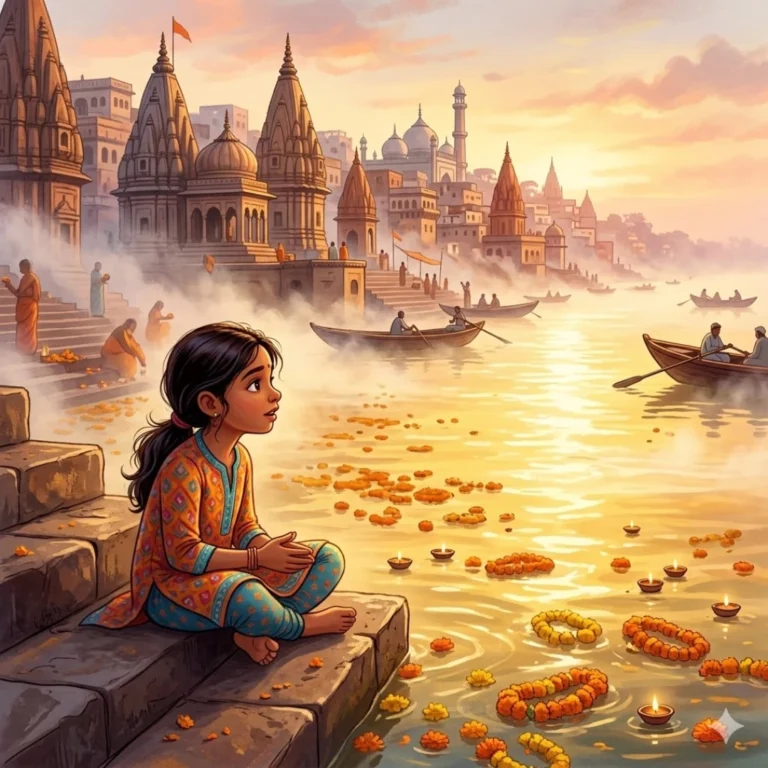
Hear now the old lesson of the Ganga, great river, silver daughter of the mountains, who carried the prayers of millions in her current and grew proud of it – and hear the story of the child who reminded her what pride costs a thing that is already great.
The Ganga rises in the glacier of Gangotri in the high Himalayas, where the snow is so old it has forgotten how to be rain, and she runs four hundred miles through the mountain passes and out into the plains of the north, spreading and dividing and growing wide and rich and brown with the silt of mountains. She is sacred beyond almost any other thing in the land. People travel from everywhere to touch her. People bring their loved ones to her banks. People put their hands in her cold current and feel something very old and very patient flowing through their fingers.
The Ganga knew all of this. She knew it the way great rivers know themselves – deeply, continuously, in every swell and current. And she had, over many centuries of being sacred, developed a certain confidence about her importance.
This is where Priya comes in.
Priya was ten years old, and she lived in the city of Varanasi where the ghats descend to the river in wide stone steps and the morning mist comes off the water smelling of incense and marigold and something older than both. She had grown up beside the Ganga the way city children grow up beside great landmarks: so accustomed to its presence that it was simply always there, the way air is always there.
On the morning of her birthday, she went alone to the river before sunrise, which was her habit on important days. She wanted to think without her four younger siblings providing a commentary.
She sat on the lowest ghat step with her feet just above the water and looked at the mist rising off the Ganga in the dawn light.
“Why are you so famous?” she asked the river, because ten is the age when you have become confident enough to ask rivers questions.
The Ganga, who had been asked many questions in her long existence but mostly of the reverential kind, found this one interesting.
“I am sacred,” she said, in the voice of deep water. “I carry the prayers of a billion people. I began in the glacier of Gangotri. I empty into the sea at Sagar. I am ancient and -“
“Yes, but why?” said Priya. “The Yamuna is also ancient. The Narmada is also sacred. What makes you you?”
The Ganga was quiet.
This was, in truth, a question she had not been asked. People told her what she was. They did not ask her to justify it. The question felt like being looked at directly by someone who had decided to see clearly rather than reverentially.
“I carry the mountains to the sea,” she said. “I bring water to the plains. Without me -“
“Without you, it would rain differently,” said Priya, who had been paying attention in school, “and the plains would be different, and people would adapt, as people do. What are you that no one else is?”
The river thought for a long time. The mist moved across her surface. The first boats of the morning appeared upstream, taking pilgrims across her width.
“I have been carrying things for a very long time,” the Ganga said slowly. “And perhaps I have mistaken what I am for what people say I am. I carry silt. I carry prayers. I carry seeds and fish and the ashes of people’s loved ones and the soap of people’s laundry and all the small daily things as well as the sacred ones.”
“Yes,” said Priya.
“And I do this because it is what I am, not because I am important.” A pause, in which much water flowed. “I think I may have forgotten that.”
“My grandfather says the most important thing about an important thing is that it does not need to announce itself. The Himalayas don’t announce themselves. They’re just there.”
“Your grandfather is a wise man.”
“He is also very annoying,” said Priya, “and says the same thing seventeen times, and was right all seventeen times, which is the worst kind of correct.”
The Ganga made a sound that rivers make when they are amused, which is a particular quick-water sound over flat stones.
“What is it you want to know?” the river asked.
“I want to know if I should be a doctor or a teacher. I am ten today and this has been bothering me for several weeks.”
“That,” said the Ganga, with the settled patience of something very old, “is not a question for a river. That is a question for the next twenty years, which will answer it by the living of them.”
Priya considered this. “That is either wisdom or an evasion.”
“Both,” said the river. “Most wisdom is. But here is what I know: you asked me a question that no one in a very long time has bothered to ask. You looked at me as if I were simply a river, which I am – among all the other things. People who see what is actually there rather than what they expect to see often become exactly the kind of doctor or teacher or something-else that is needed.”
Priya took this with her when she left, which she did when the sun had fully risen and her family would be wondering about breakfast.
She did not know, at ten years old, that she would one day build water filtration systems for villages downstream of Varanasi, which would help people who could not afford to buy clean water – which is to say, she would spend her life in service to the river and the people the river served, which is a kind of answer that can only be given in the living.
The Ganga flowed on, as she always did, carrying everything with equal dignity: the silt and the prayers, the laundry and the ashes, the seeds and the boats, the dawn and the child who had asked the question she needed to be asked.
This is true greatness: not the announcement but the carrying. Not the monument but the current. Not the name but the work, done faithfully, since before the remembering of it, for as long as the mountains have snow.
The Moral of This Story
True greatness kneels. The mountain does not need to announce itself
About This Story’s Culture
The Ganga (Ganges) is the most sacred river in Hinduism, personified as a goddess (Ganga Mata) who descended from heaven to earth. Varanasi (also called Benares or Kashi) is the holiest city in Hinduism, one of the world’s oldest continuously inhabited cities, where the ghats (stepped stone riverbanks) descend to the Ganga for ritual bathing and cremation. Gangotri glacier in the Himalayas is the source of the Ganga. The Yamuna and Narmada are other sacred rivers in Hindu tradition. The story engages authentically with the Hindu concept of sacred rivers (tirthas – crossing places) while subverting the expected reverence to explore the concept of ahankara (ego/pride) and vinaya (humility) – central concerns in Hindu philosophy. The name Priya means ‘beloved/dear one’ in Sanskrit and is a common Hindu female name. The tradition of visiting rivers at dawn for prayer and reflection is authentic to Hindu practice throughout India.
Key Story Elements
- Priya – a ten-year-old girl from Varanasi who asks the Ganga a question no one has bothered to ask
- The Ganga herself – proud of her sacred status, reminded by a child what she actually is
- The question: ‘Why are you famous?’ – seeing the river as a river, not only as an idea
- Kipling’s bardic opening: ‘Hear now the old lesson’ and closing proclamation about true greatness
- The grandfather’s wisdom: the most important thing does not need to announce itself
- The Ganga’s humility: confusing what she is with what people say she is
- The living answer to the ten-year-old’s question about her future – only given in the twenty years of living it
Frequently Asked Questions
What is ‘The River That Learned to Listen’ about?
It’s a Hindu-tradition story for kids aged 6-12 about the Ganga, the sacred river of India, who grows proud of her greatness until a child teaches her a humbling lesson. The story explores the theme of humility and what pride can cost even the most revered things in the world.
What is the moral lesson in this humility story for kids?
The story teaches children that greatness and pride don’t have to go together. Even something as powerful and sacred as the Ganga can lose sight of humility. The moral is that truly great things become even greater when they stay open to listening and learning, no matter how small the teacher.
Is ‘The River That Learned to Listen’ based on Hindu tradition?
Yes, the story is rooted in Hindu tradition and draws on the sacred significance of the Ganga river, which originates in the Gangotri glacier in the Himalayas. Millions of people consider the Ganga holy, making her pride and eventual humility all the more meaningful within this cultural and spiritual context.
📚 Recommended Books
Handpicked for readers like you
As an Amazon Associate, we earn from qualifying purchases. These recommendations are personalized based on this story's themes and your reading history.
What age group is this humility story suitable for?
The story is recommended for children aged 6 to 12. The language is rich but accessible, with an estimated reading time of 8 to 10 minutes. It works well as a read-aloud for younger children and an independent read for older ones, and it’s a great starting point for conversations about pride and humility.
Who teaches the Ganga her lesson in the story?
The Ganga’s humbling lesson comes from a child — a reminder that wisdom and important truths don’t always come from powerful or ancient sources. This is a recurring theme in many traditional stories: that children, often overlooked, can carry insights that even the greatest rivers, mountains, or elders need to hear.