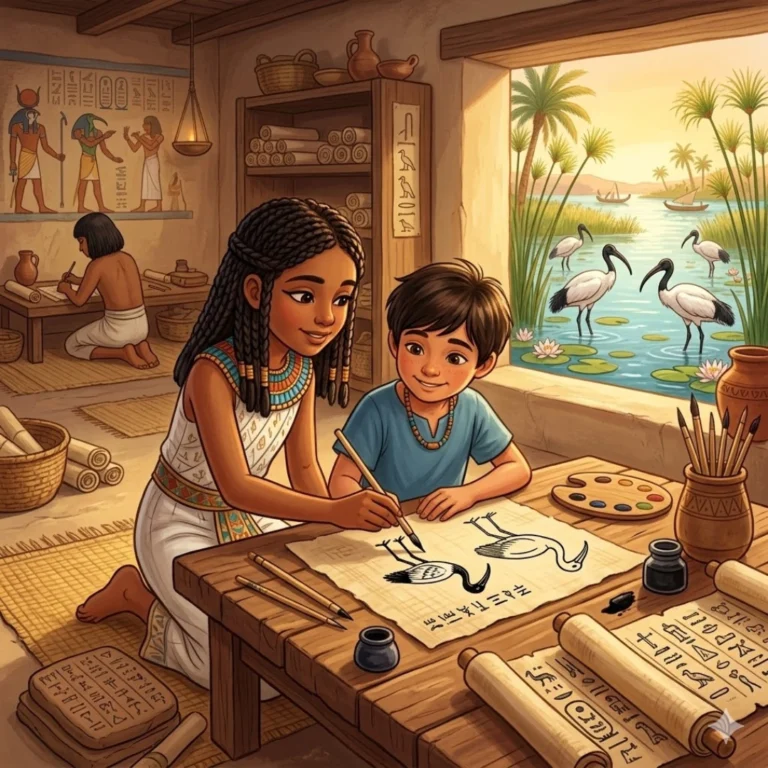
At the edge of the great papyrus marshes, where the Nile breathed out its green breath and the ibises stood in the shallows like white thoughts above the dark water, there was a scribe’s house.
The scribe’s name was Kha, and she was twelve years old, which was old enough to be a proper scribe’s apprentice in the household of the temple at Abydos, and she was very serious about her work. She had serious eyes and careful hands and the specific quality of concentration that makes a very good scribe: the ability to sit absolutely still for hours while her reed pen moved and the words accumulated on the papyrus like sediment building slowly into record.
She wrote everything. The temple records. The inventory of grain. The letters of merchants who could not write for themselves. The prayers that needed to be accurate because inaccuracy in a prayer was, as her teacher had told her repeatedly, a problem for everyone.
Her teacher was old Mentu, who had been writing for fifty years and whose hands had the curved, precise quality of tools that have been used for a single purpose long enough to show it in their shape. He said very little beyond what was necessary, which was either wisdom or efficiency – Kha suspected both.
On a morning in the month of Pharmuthi, when the marshes were loud with birds and the air smelled of mud and growing things, a child appeared at the door of the scribe’s house.
He was young – perhaps seven – and very thin, and he was dusty in the way that meant he had been traveling, and he had the look of someone who is not sure they are welcome but has run out of other options.
“Can I have water?” he said.
“Come in,” said Kha.
Old Mentu, who was behind her, said nothing, which was his way of approving.
The boy’s name was Ramose, and he had been walking since the previous dawn from the village three days east, which explained the dust and the thinness and the look. His family was traveling west to a relative’s house in Memphis, and he had become separated from them at a market, and he had walked in the direction of the river because the river was where people were, and he had found the scribe’s house at the marsh’s edge.
“Are they looking for you?” Kha asked.
“Yes,” he said, with the certainty of a child who knows his family. “They will go to Memphis and then come back for me if they cannot find me. But that is many days.”
Kha gave him water and bread and the remains of the morning’s breakfast, which were considerable because Mentu ate very little and Kha had made too much. While Ramose ate with the focused attention of someone who has been hungry, she thought about the problem.
The problem was: Memphis was three days east, but the market was on the river road, and traders went up and down the river road daily, and if she wrote a letter and gave it to the right person, it would reach the market long before Ramose’s family reached Memphis.
This was exactly what scribes were for.
She wrote two letters. The first was to the market overseer at the market town, asking him to stop any family matching her description of Ramose’s family and tell them their son was safe at the scribe’s house in the papyrus marsh. The second was the same letter, to be sent by a different trader in case the first missed them.
She paid for both deliveries from her own small savings, which was not nothing.
Old Mentu watched her write, seal, and dispatch both letters without commenting until they were gone.
“You wrote two,” he said.
“In case one was lost,” she said.
Mentu said nothing for a moment. Then: “The grain records must be checked before the evening meal. Take the boy with you, he can carry the tablet.”
This was his way of saying: that was right and you may continue.
Ramose stayed three days. He turned out to be curious about writing, which Kha found immediately interesting because people were either curious about writing or they weren’t, and the ones who were seemed to her to be a particular kind of person.
She taught him the ibis hieroglyph, which was fitting because the ibis was the symbol of Thoth, god of writing and knowledge and the careful recording of things. She taught him the river glyph and the sun glyph and the glyph for bread, which was one of the most important.
“Why are you teaching me?” he asked.
“Because you asked about it, which is the only good reason to teach anyone anything.”
“But you don’t have to.”
“No.” She dipped the reed pen and held it toward him. “Try the ibis again. Start from the beak.”
He started from the beak.
His family arrived on the afternoon of the third day, having received the letter at the market and come straight back. His mother held him for a long time without speaking.
They offered payment, which Kha refused. They offered gratitude, which she accepted because that is what you do with gratitude.
As they were leaving, Ramose turned back.
“I am going to learn to write,” he said. “Properly.”
“I know,” said Kha.
Old Mentu watched them go from the doorway. He was quiet for a long time after.
“The letters,” he said at last. “Both of them.”
“Yes?”
“The papyrus lasts a thousand years,” he said. “The words on it last as long as there are eyes to read them. But a kindness given without calculation” – he paused in the way of someone who does not often say things directly – “lasts in the person who receives it for all of their years, and they carry it forward, and it multiplies in ways that cannot be measured.”
Kha looked at the ibis in the shallows – white and still, its beak a perfect curve, its reflection in the water equally perfect.
“Longer than the monuments?” she asked.
“Much longer than the monuments,” said old Mentu, with the certainty of someone who has been recording history long enough to have noticed what survives.
He went back inside to his own work.
Kha picked up her reed pen and opened a fresh sheet of papyrus, and outside in the marsh the ibises stood in the morning water, white and patient, writing nothing and meaning everything.
The Moral of This Story
Kindness is the longest-lasting magic – it outlives every monument
About This Story’s Culture
This story is set in ancient Egypt, specifically in the region of Abydos, one of Egypt’s most important ancient religious centers (in modern-day Upper Egypt, near the town of Sohag). Abydos was home to a major temple complex and was considered the sacred center of the cult of Osiris. The ibis was the sacred bird of Thoth (Djehuty), the god of writing, wisdom, and the moon – scribes were considered Thoth’s servants. Scribes (seshu) were highly trained professionals in ancient Egypt; the scribal schools (per-ankh, ‘houses of life’) trained students from childhood. Papyrus scrolls were the writing medium of ancient Egypt, and the reed pen (calamus) was the primary writing instrument. Pharmuthi (also spelled Paremoude) is an authentic month in the ancient Egyptian calendar corresponding to approximately March-April. The names Kha and Ramose are authentic ancient Egyptian names. Memphis was the ancient Egyptian capital in the north, near modern Cairo.
Key Story Elements
- Kha – a twelve-year-old Egyptian scribe’s apprentice with serious eyes and careful hands
- Old Mentu – the fifty-year scribe who teaches through doing and approves through silence
- Ramose – the lost seven-year-old who arrives dusty and hungry and curious about writing
- Two letters sent by two different routes – practical kindness amplified by professional craft
- Potter’s close domestic attention: grain records, morning breakfast leftovers, reed pen in water
- The ibis as Thoth’s symbol – writing, knowledge, the careful recording of things
- Mentu’s final wisdom: kindness multiplies in ways that cannot be measured, outlasting monuments
Frequently Asked Questions
What is The Ibis Scribe and the Desert Child about?
The Ibis Scribe and the Desert Child is an Egyptian folktale-style story for kids aged 6-12 about a young apprentice scribe named Kha who lives near the Nile papyrus marshes. The story explores themes of kindness, responsibility, and what it means to use your skills to help others.
What age group is The Ibis Scribe and the Desert Child suitable for?
This story is written for children aged 6 to 12. Younger kids will enjoy it read aloud, while older readers in the 9-12 range can explore it independently. It takes around 8 to 10 minutes to read from start to finish.
What moral or lesson does this Egyptian story teach children?
The central theme is kindness — specifically how using your talents and knowledge to help someone in need is a meaningful act of generosity. Set against an ancient Egyptian backdrop, the story shows young readers that even everyday skills like writing can make a powerful difference in someone else’s life.
📚 Recommended Books
Handpicked for readers like you
As an Amazon Associate, we earn from qualifying purchases. These recommendations are personalized based on this story's themes and your reading history.
Is this story based on real ancient Egyptian traditions?
The story draws inspiration from real ancient Egyptian culture, including the role of scribes, the significance of Abydos as a temple city, and the importance of accurate prayer and record-keeping. While the characters are fictional, the setting and details reflect genuine historical customs from ancient Egypt.
Who is Kha in The Ibis Scribe and the Desert Child?
Kha is a twelve-year-old scribe’s apprentice at the temple of Abydos. She is described as serious, precise, and deeply focused — qualities that make her exceptionally skilled at writing. Her story begins near the Nile marshes, where ibises wade in the shallows outside her teacher Mentu’s house.