

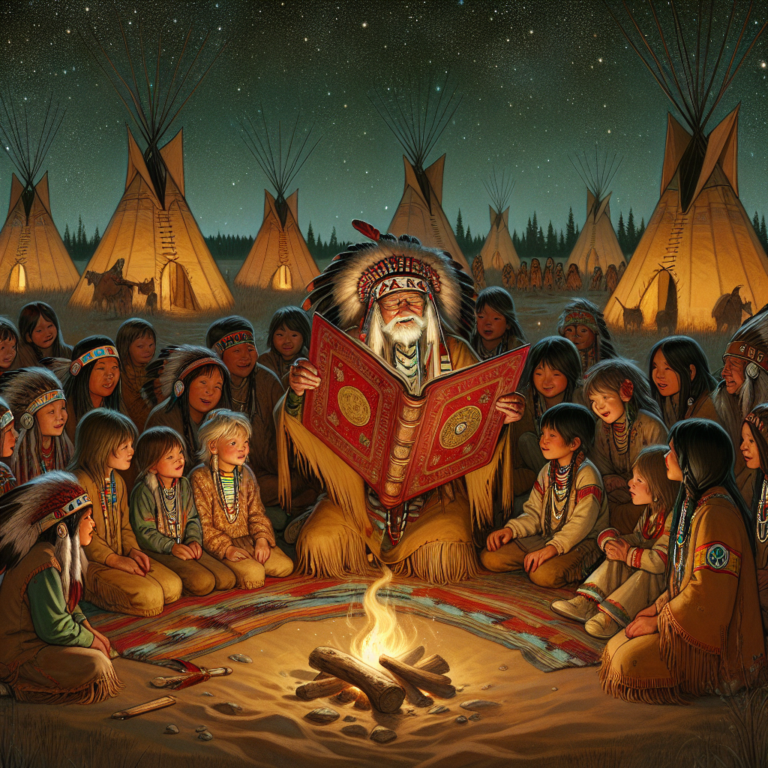
In the time before time was measured by clocks, when the great herds of buffalo still thundered across the endless prairie and eagles spoke to those who knew how to listen, there lived a boy of the Lakota people named Chaska, which meant “first-born son.”
Now, Chaska was peculiar. At least, that’s what everyone said.
When the other boys practiced with their bows, shooting arrows straight and true at targets, Chaska would shoot his arrows in wild loops and spirals, trying to make the flight path beautiful rather than accurate.
When the other boys learned to track deer by following their hoofprints in the earth, Chaska would lie on his back and track clouds instead, naming them “Sky Buffalo” and “Thunder Birds” and “The Great Spirit’s Moccasin.”
“That boy has his head in the clouds,” the hunters would say, shaking their heads.
“That boy thinks sideways,” the elders would mutter.
But Chaska’s grandmother, Winona, who was very old and very wise, would smile and say, “That boy sees what others cannot. That is a gift, though he doesn’t know it yet.”
One summer, a terrible problem came to Chaska’s village. The buffalo had changed their migration route and no longer passed through the valley where the Lakota hunted. Without the buffalo, the people would have no meat for the winter, no hides for clothing and lodges, no sinew for bowstrings.
The best hunters went out in all directions, searching for the buffalo herd. They tracked for days and days, following every sign, using every traditional method passed down through generations. But the buffalo had vanished as completely as if they’d been swallowed by the earth.
The village council gathered in the great tipi, sitting in a circle around the central fire. The smoke rose through the hole at the top, carrying their worried thoughts to the sky.
“We must find the buffalo before the cold moons come,” said Tashunka, the chief, his face grave with concern.
“We have tried all the old ways,” said Chayton, the greatest hunter. “We have followed every trail, checked every valley and plain. It is as though the buffalo have learned to fly.”
Chaska, who had been sitting quietly in the back, suddenly sat up straight. “What if they have?” he said.
“What if they have what?” Chayton asked irritably.
“What if the buffalo have learned to fly? Not really flying, but what if we’re looking for them the wrong way? What if we need to think differently?”
The hunters laughed, but not kindly.
“Stupid boy,” one muttered. “Buffalo don’t fly.”
“This is a serious matter,” another said. “We don’t have time for foolish games.”
But Grandmother Winona stood up, her blanket wrapped around her bent shoulders. “Let the boy speak. Sometimes wisdom wears a fool’s clothing so it can sneak past proud men who think they know everything.”
The hunters fell silent out of respect for the old woman.
Chaska stood, his heart beating fast. “You’ve been tracking the buffalo on the ground, looking at where they’ve been. But what if we track them through the sky? What if we watch where the eagles fly, because eagles can see the whole prairie at once? What if we follow the thunder clouds, because buffalo and thunder are cousins—both make the earth shake?”
“Ridiculous,” Chayton snorted. “We should listen to birds and clouds instead of following real tracks?”
“All of our real tracks have led nowhere,” Grandmother Winona pointed out. “Perhaps it is time to try what seems ridiculous. What do we have to lose?”
Chief Tashunka was quiet for a long moment, thinking. Finally, he nodded. “Very well. Chaska, you will take three hunters and search for the buffalo your way. But you have only five days. If you fail, we will send parties to trade with distant villages for what we need, though the price will be dear.”
The next morning, Chaska set out with three hunters who had agreed to come—though mostly because no one else wanted to go on what they called “the crazy journey.”
Instead of following hoofprints and broken grass, Chaska did what he’d said. He watched the eagles. He noticed that every morning and evening, they flew in a great circle toward the northeast, returning with full bellies.
“Eagles are hunting something that way,” Chaska said. “Something big enough to feed them well.”
He watched the clouds. He noticed that the thunder clouds gathered more thickly to the northeast, and when he put his ear to the ground, he could feel a faint, rhythmic trembling in that direction.
“Thunder in the earth,” he whispered. “Just like buffalo hooves.”
The hunters were skeptical, but they followed.
As they traveled, Chaska did other strange things. He collected colored clay and charcoal. He picked flowers and berries. He gathered feathers that birds had dropped.
“What are you doing?” the hunters asked, exasperated. “This isn’t a journey to gather pretty things.”
“I’m thinking differently,” Chaska said mysteriously.
On the third day, they reached a place where the prairie ended and rough badlands began—a maze of twisted canyons and odd-shaped rocks that looked like giants had been playing with clay and forgotten to clean up.
“No buffalo would go into that maze,” the hunters declared. “That’s why no one tracks there. It’s impossible terrain.”
“Impossible for us,” Chaska agreed. “But what if it’s perfect for buffalo who want to hide from hunters? What if they’ve learned that we won’t follow them there?”
The hunters grumbled, but they’d come this far. They entered the badlands.
The canyons twisted and turned, splitting and rejoining in a pattern that made no sense. After an hour, the hunters were completely lost and very angry.
“We’re going in circles!” Chayton’s cousin, Hanska, shouted. “This is hopeless!”
“No,” Chaska said, pulling out his collection of colored clays and flowers. “We’re not lost. We’re going to mark our path—not with broken branches that all look the same, but with colors! Red for where we’ve been, blue for dead ends, yellow for promising paths.”
He began painting symbols on the canyon walls—not traditional symbols, but his own whimsical designs: spirals for confusion, arrows with smiling faces for good directions, clouds with frowns for wrong turns.
The hunters thought he was completely mad, but they had to admit, his colorful marks were much easier to follow than broken twigs or scratched arrows.
Using this new method, they began mapping the badlands systematically. And on the evening of the fourth day, as the sun painted the canyon walls orange and gold, they climbed a tall outcropping and looked down into a hidden valley.
There, spread across green grass beside a clear stream, was the entire buffalo herd—hundreds and hundreds of them, peaceful and safe in their secret canyon fortress.
The hunters stared in amazement.
“He found them,” Hanska whispered. “The boy who everyone said was touched in the head actually found them.”
“By thinking sideways,” another hunter said, a new respect in his voice. “By watching eagles and thunder clouds. By painting happy faces on rocks. By doing everything differently from how we’ve always done it.”
But Chaska wasn’t finished surprising them.
“We can’t hunt them here,” he said.
“What?” The hunters turned to him in shock. “Why not? We found them! This is what we came for!”
“If we hunt them here, they’ll panic and scatter deeper into the badlands where we’ll never track them again,” Chaska explained. “We need to guide them back to our valley. We need to convince them to return to the old migration route.”
“That’s impossible,” Hanska said flatly. “You can’t convince buffalo to go where you want them to go.”
Chaska smiled his sideways smile. “Not the old way. But what if we try a new way?”
He explained his plan. The hunters thought it was the craziest thing they’d ever heard. But they’d followed him this far, and he’d been right about everything else.
The next morning, Chaska and the hunters positioned themselves at different points around the hidden valley. They each carried bundles of the sweetgrass that buffalo loved, mixed with sage and cedar.
They lit the bundles so they smoked richly, and they began to move slowly through the badlands, creating a trail of wonderful-smelling smoke that led back toward the open prairie and the village’s valley.
At the same time, Chaska made sounds—not hunting sounds designed to drive and frighten, but gentle sounds. He had noticed that thunder always preceded rain, and buffalo loved rain. So he and the hunters made gentle thunder sounds with drums they’d made from hollow logs, creating a rumbling that echoed off the canyon walls like a summer storm.
The buffalo smelled the sweetgrass smoke. They heard the thunder sounds. Something ancient in their buffalo hearts responded. Slowly, curiously, they began to follow the smoke and the drums, thinking perhaps a good storm was coming, the kind that brought fresh grass and cool water.
For two days, Chaska and the hunters led the buffalo herd back through the badlands, following the colorful marks Chaska had painted, using sweet smoke and gentle drums instead of arrows and shouts.
And on the evening of the fifth day—just as the chief had said was their limit—the buffalo herd emerged from the badlands and flowed like a brown river back into the valley where the Lakota people hunted.
The village erupted in celebration. The hunters who had gone with Chaska told the story again and again—how the strange boy had tracked buffalo through clouds and eagles, how he’d painted happy faces to find his way through impossible canyons, how he’d led hundreds of buffalo home with nothing but sweet smoke and thunder drums.
Chief Tashunka honored Chaska before the entire village. “You have saved your people,” he said, placing a sacred eagle feather in Chaska’s hair. “You did it by thinking differently, by seeing what others could not see, by trying what others said was impossible.”
But Grandmother Winona’s gift was better. She gave him a parfleche bag—a beautiful painted carrying case—filled with colored clays, charcoal for drawing, and eagle feathers.
“For the boy who paints thunder,” she said with a smile. “Never stop thinking sideways, Chaska. Never stop seeing differently. The old ways are good and must be honored. But new ways are how the people survive when times change.”
From that time forward, whenever the village faced a problem that the old solutions couldn’t solve, they would say, “Let’s ask Chaska. Let’s think differently.”
And Chaska grew up to be a great leader, not because he was the strongest or the fastest or the best hunter, but because he could look at problems from angles that no one else considered. He invented new ways to preserve food, new designs for lodges that stood stronger in storms, new methods for teaching the children.
His way of thinking spread through the village and beyond, teaching everyone that creativity and innovation weren’t foolish—they were essential. That sometimes the boy with his head in the clouds could see farther than the man with his nose to the ground.
And late in his life, when young people came to ask him how to solve their problems, Chaska would tell them about the summer he found the buffalo by following eagles and painting happy faces on canyon walls.
“Don’t be afraid to think differently,” he would say. “The path everyone else follows is good—until it leads nowhere. Then you need someone who’s willing to follow clouds, paint thunder, and walk sideways through the world. Be that person. The most powerful medicine isn’t always found in the old ways or the new ways. It’s found in the wisdom to know when to use each, and the courage to try what’s never been tried before.”
And if you ever find yourself in the badlands of the Great Plains, look closely at certain canyon walls. Some say you can still see faded paintings—spirals and smiling arrows and clouds with faces—left by the boy who thought differently and saved his people by doing what everyone said was impossible.
Because that’s the secret power of creativity: it turns impossible into possible, as long as you’re willing to think sideways, paint thunder, and follow eagles through the sky.
Moral of the Story
Think differently to solve problems
Frequently Asked Questions
What is the moral lesson of The Boy Who Painted Thunder – A Native American Creativity Story for Kids?
What age is this story appropriate for?
How long does it take to read The Boy Who Painted Thunder – A Native American Creativity Story for Kids?
What culture does this story come from?
Can I use this story for teaching?
Frequently Asked Questions
What is the story of The Boy Who Painted Thunder about?
The Boy Who Painted Thunder is a Lakota-inspired children’s story about a boy named Chaska who thinks and sees the world differently from others. While his peers focus on traditional skills, Chaska finds beauty in unexpected places, teaching readers that unique ways of seeing the world are a gift, not a flaw.
What moral lesson does The Boy Who Painted Thunder teach kids?
The Boy Who Painted Thunder teaches children that being different is a strength, not a weakness. Chaska is seen as peculiar by his community, but his grandmother recognizes his unique perspective as a special gift. The story encourages kids to embrace their individuality and creative thinking.
Is The Boy Who Painted Thunder based on Native American culture?
Yes, the story draws inspiration from Lakota Native American culture and tradition. It features characters from the Lakota people, references the buffalo herds of the prairie, and includes cultural naming conventions, giving children a respectful glimpse into Indigenous storytelling traditions.
📚 Recommended Books
Handpicked for readers like you
As an Amazon Associate, we earn from qualifying purchases. These recommendations are personalized based on this story's themes and your reading history.
What age group is The Boy Who Painted Thunder suitable for?
The Boy Who Painted Thunder is well suited for children aged 5 to 12. Its imaginative storytelling, relatable characters, and gentle moral message make it ideal for bedtime reading, classroom discussions, or any parent looking for meaningful stories that celebrate creativity and self-acceptance.
Who is Chaska in The Boy Who Painted Thunder?
Chaska is the main character in The Boy Who Painted Thunder. His name means ‘first-born son’ in Lakota. Unlike other boys in his tribe, Chaska is a dreamy, creative thinker who tracks clouds instead of deer and finds beauty in arrow flight paths, making him both misunderstood and quietly extraordinary.
