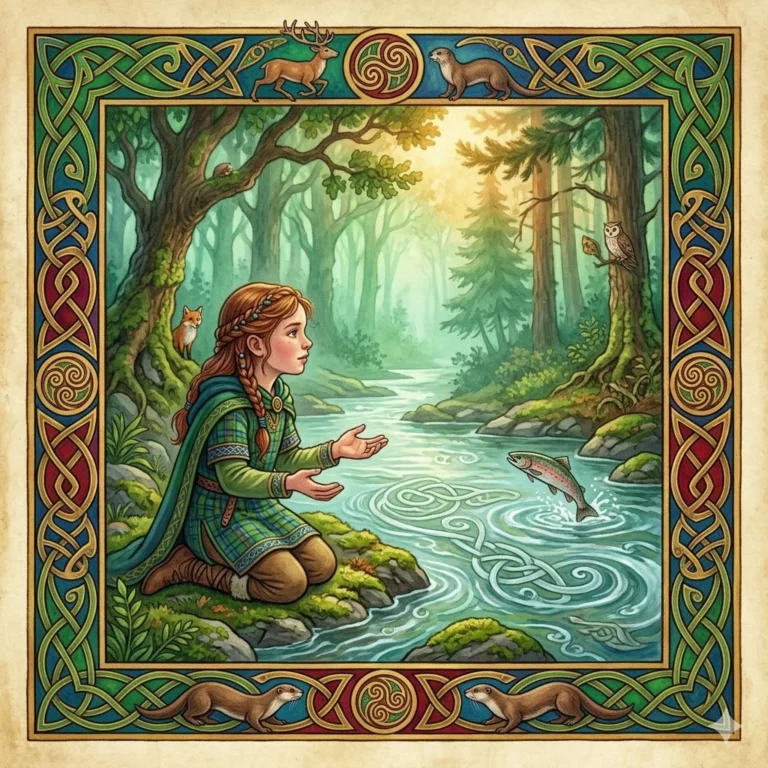
The Girl Who Asked the River
—
The River Bán had always sung.
Every morning in the village of Ardmore, the people woke to its voice — a bright, tumbling chatter of water over smooth grey stones, carrying the smell of cold peat and wild mint through every open window. The river fed the barley fields, filled the cooking pots, and kept the cattle strong. Without it, the village would wither like a cut flower in July.
So when the river fell silent one autumn, panic spread faster than frost.
It happened overnight. One morning the riverbed was simply… dry. Cracked mud where silver water had rushed. A few sad puddles clouding with silt. Even the willows along the bank drooped, their trailing fingers touching nothing, as if searching for something lost.
The village chief, Brennan, a broad-shouldered man with a red beard plaited to his chest, called together his three best warriors.
"Something has stopped the river upstream," he declared. "Go to the headwaters. Find what blocks it. Move it by force if you must."
The warriors rode out at dawn. By midday they returned, pale and shaking.
"There is a creature there," said the first warrior, his voice barely above a whisper. "A great grey heron, still as carved stone, standing in the source pool. When Colm raised his spear, it turned one eye on him and he could not move his arm."
"When I shouted at it," said the second, "my own voice came back at me like a blow."
"And when I tried to wade past it," said the third, rubbing his shin, "the cold of that water stopped my heart for a full three beats."
Chief Brennan stroked his plait and said nothing.
That evening, a girl named Saoirse sat by the empty riverbank alone. She was nine years old, slight as a reed, with dark hair full of river mud from an afternoon of searching the shallows for clues. She pressed her palm flat against the cracked earth where water had been, feeling the damp ghost of it still hiding beneath.
She had listened to every word the warriors said.
*It blocked the source,* she thought. *But it didn't chase them away. It just stopped them from passing.*
She made her decision before the stars appeared.
At dawn — that gauzy, grey-gold hour when the world holds its breath — Saoirse crept upstream alone. The forest smelled of damp bark and fallen leaves, mushroom-rich and ancient. Twigs snapped softly under her bare feet. The trees grew closer together the further she walked, their roots knotted like old fingers reaching into the soil.
Then she heard it. Not silence — something deeper than silence. A stillness with weight to it.
She stepped into the clearing and saw the source pool.
It was small, barely wider than a cottage, perfectly round, and perfectly blocked. The great grey heron stood at its centre, up to its knobbed knees in dark water. It was enormous — taller than any heron she had ever seen, its feathers the colour of a winter sky, its eye a disc of molten amber.
Saoirse felt the fear move through her like cold water. Her knees wanted to turn her around. Her throat tightened.
She stood still and let the fear pass through her, the way her grandmother had taught her to let a storm pass — without fighting it.
Then she spoke.
"Good morning," she said. "Are you guarding something, or waiting for something?"
The heron turned its great head slowly. That amber eye found her.
"Most who come here shout or wave iron at me," it said. Its voice was like wind through reeds — dry, rustling, old. "You are the first to ask a question."
"I didn't think shouting would help," Saoirse said. "You don't look frightened of noise."
"What do you want, small one?"
"I want to understand why the river stopped. The village needs the water."
The heron was quiet for a long moment. A dragonfly, impossibly blue, landed on the water's surface and skimmed away.
"A fisherman," the heron said at last, "placed iron hooks across the mouth of this pool three nights ago. They tore my feet when I tried to leave. I have not moved since, for fear of them."
Saoirse blinked. She waded into the shallows — the cold hit her ankles like a gasp — and felt along the muddy bottom with her toes until she found the hooks, three of them, rusted and sharp, half-buried in silt. One by one she worked them loose, wincing, and tossed them onto the bank.
"There," she said.
The heron lifted one foot, then the other, testing. It stretched its great wings — a sound like a sail catching wind — and rose into the pale morning air without a single word more.
And the river answered.
It did not trickle back. It *rushed* — a silver roar filling the dry bed, frothing over the smooth stones, cold and clean and smelling of mountain moss and sky. Saoirse stood knee-deep in the surge of it, laughing, the water pulling at her dress like an old friend demanding attention.
When she walked back into Ardmore, soaking wet and grinning, the village was already gathered at the riverbank, staring in disbelief at the restored water.
Chief Brennan looked at her for a long moment.
"How?" he asked.
📚 Recommended Books
Handpicked for readers like you
As an Amazon Associate, we earn from qualifying purchases. These recommendations are personalized based on this story's themes and your reading history.
Saoirse wrung the water from her sleeve and shrugged. "I asked," she said.